Halloween, traditionally celebrated on the 31st of October, is most famously associated with spooky costumes, trick-or-treating, and haunted houses. However, around the world, various countries have added their unique spin to this eerie festival to reflect their customs and beliefs. There’s no denying that Halloween is one of my favourite times of the year but I find it super interesting to see other Halloween traditions from around the world. From remembering the dead to warding off evil spirits, let’s take a look at 13 unusual Halloween traditions from across the globe.

How Is Halloween Celebrated in Different Countries?
Although Halloween has its roots in Celtic traditions, it has transformed into a global event, taking on different customs and cultural meanings in various countries. In the UK and the US, it’s all about costumes, candy, and haunted houses. America has really commercialised many Halloween traditions and seems to have a deep love of the holiday but despite the UK’s slightly more reserved nature, we are catching up with some Halloween love here too.
However, not everywhere celebrates spooky season the same. In places like Mexico, Halloween is intertwined with “Día de los Muertos,” a festive celebration honouring the dead. Some countries have strong beliefs towards the afterlife and ghosts so things are done very differently to what you might expect to see in the UK or America.
Many countries around the world celebrate Halloween with customs that reflect their unique beliefs, histories, and superstitions. From quiet, sombre rituals to quirky, joyful festivities, Halloween is as diverse as the cultures that celebrate it.
What Country Started the Tradition of Halloween?
The origins of Halloween can be traced back to the ancient Celts, particularly in areas now known as Ireland and Scotland. They celebrated a festival called Samhain, marking the end of the harvest season and the beginning of winter. Samhain was believed to be the time when the boundary between the living and the dead was thinnest, allowing spirits to walk the earth. As Christianity spread, Samhain became intertwined with All Saints’ Day and All Hallows’ Eve, eventually evolving into the modern Halloween we know today.
Now, let’s explore some of the more unusual Halloween traditions from around the world!
1. Austria: The Practice of Leaving Bread, Water, and Lights for Spirits
In Austria, locals practice a tradition known as “Seelenwoche“ (Soul Week), starting on the night before Halloween. Austrians believe that the dead visit their homes during this time, so they leave bread, water, and a lit lamp out on the table to welcome wandering souls. This ritual is both a sign of respect for ancestors and an invitation for good spirits to visit.
This period of time usually sees families gathering at gravesides and going to church but rather than being a period of mourning, it’s seen as a magical time of year to welcome the souls of loved ones back to Earth.
2. Philippines: Pangangaluluwâ – Songs for the Souls
In the Philippines, a custom called Pangangaluluwâ sees children going from house to house, singing songs to honour the dead. In return, they receive food or small gifts, somewhat similar to trick-or-treating. The practice is seen as a way of praying for the departed, and the songs are often deeply spiritual.
This Halloween tradition is usually observed in more rural areas where people tend to have more deep-rooted beliefs. Food is sometimes prepared on All Saints Day (1st November) to welcome those who died on the day back to the world of the living.
3. Italy: Fava Beans for the Dead
In Italy, Halloween isn’t as widely celebrated as it is in the UK or US, but in some regions, people prepare fave dei morti, or fava beans, as a symbolic offering for the dead. This ancient tradition is still followed in certain rural areas, where it’s believed that the spirits of the deceased return to taste the food left out for them.
Despite the name, fava beans are actually an almond cookie shaped like a broad bean. The name can refer to the cookie’s shape or the connection between beans and death.
4. Germany: Hiding Knives from Ghosts
In Germany, some families have an unusual Halloween tradition where they hide all sharp objects, especially knives, on Halloween night. The belief is that returning spirits might accidentally harm themselves or others with sharp tools, so people keep them safely tucked away to protect both the living and the dead.
Like many other cultures, Germans believe that the dead can return on Halloween night but rather than see this as a bad thing, knives are hidden to take care of any loved ones who may reappear. For those not familiar with the practice, it may seem odd but it actually has quite a sweet undertone.
5. Japan: Kawasaki Halloween Parade
Japan, known for its vibrant street culture, hosts the annual Kawasaki Halloween Parade, one of the largest Halloween events in Asia. It’s not just any Halloween parade – the level of creativity in the costumes is jaw-dropping, with participants spending months preparing their elaborate outfits, and with good reason, because there’s a big cash prize on offer for the winner! It’s a spectacle, blending Japanese pop culture with Halloween themes.
Expect everything from horror movie screenings, pole dancers and spooky stuff galore. There are some family-friendly events that take place too though.
6. Mexico: Sugar Skulls
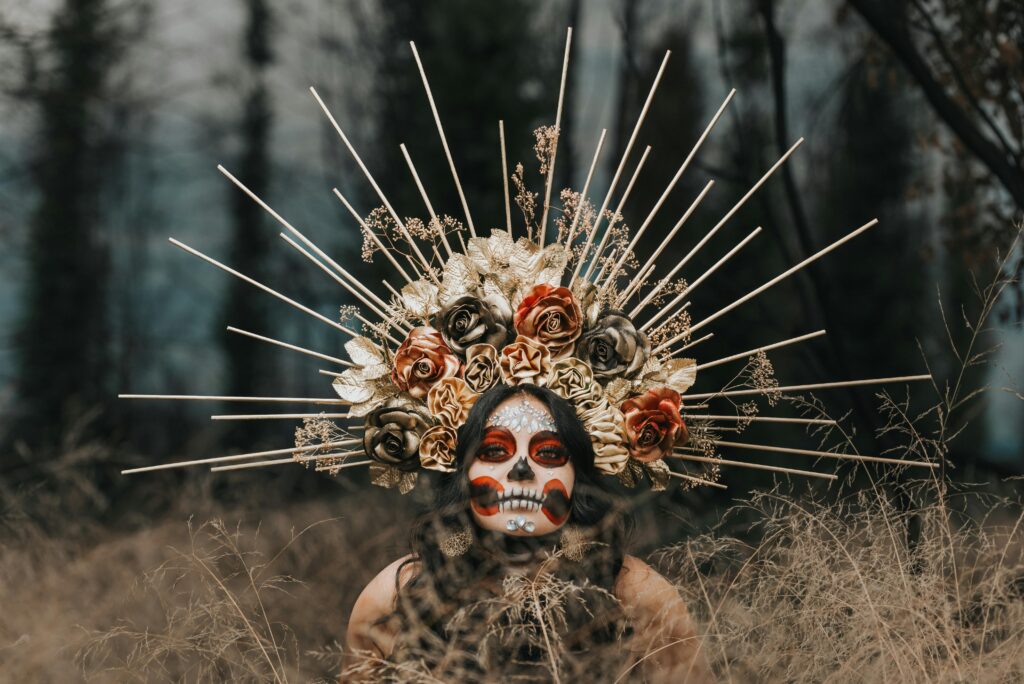
Día de los Muertos (Day of the Dead) is not a sombre or scary event like Halloween, but rather a vibrant and joyful celebration of life and death. One of the most unique aspects of the festival is the use of sugar skulls (calaveras), which are brightly decorated skull-shaped ornamental gifts that often have the name of the deceased on them. Unlike most cultures where skulls symbolise fear or mourning, in Mexico, these sugar skulls represent the sweetness of life and the playful connection with the afterlife.
Sugar skulls or often placed on the home ofrenda or the gravestone of the departed. Sugar skulls of often used in the makeup of costumes around Día de los Muertos too.
7. Portugal: Cake for the Spirits
In some parts of Portugal, people celebrate Halloween by baking “soul cakes,” small round cakes, and giving them out to honour the dead. This is known as souling which is often seen as the origin of trick-or-treating.
Soul Cakes still exist in some form in some parts of England today although it is not a well-known tradition in the UK anymore. It can be traced back to medieval times but love for this tradition began to decrease around 1930. However, countries like Portugal still hold the tradition dear and celebrate either on All Hallows’ Eve or the following day which is All Saints’ Day.
8. Romania: Halloween in Transylvania
In the famous region of Transylvania, home to the Dracula legend, Halloween is a serious affair. Visitors flock to the area for spooky tours of Bran Castle, known as Dracula’s Castle, and other Gothic landmarks. Locals and tourists alike participate in eerie, costume parties, making Romania one of the spookiest Halloween destinations.
Dracula was actually based on the real-life prince Vlad the Impaler who lived in Romania in the 15th Century and was famous for his torture methods. Bram Stoker’s Dracula was based in the region and is one of the most famous vampire novels to date.
9. Hong Kong: Festival of the Hungry Ghosts
While ghosts and the afterlife are often treated in a more lighthearted fashion in Western culture, in Hong Kong and China things are very different. As such, Halloween isn’t celebrated in the region but they do have the Festival of the Hungry Ghosts which usually occurs around August or September time.
The whole month is generally regarded as a time when ghosts and spirits come out from the lower realm. On the fifteenth day, it’s believed that this is when the realms of Heaven, Hell and the living are all open. During this time ritualistic meals are prepared, incense is burnt and papier-mache forms of material goods are burnt all as offerings for the dead.
10. Poland: Zaduszki – Lighting Candles at Cemeteries
In Poland, people observe Zaduszki, a solemn tradition in which families visit cemeteries on Halloween and All Souls’ Day to light candles on the graves of their loved ones. This occurs on the 2nd of November, just after Halloween. The sight of thousands of flickering candles illuminating the graveyards creates a serene, peaceful atmosphere and serves as a powerful tribute to the deceased.
However, the celebration is also believed to help souls in purgatory. By praying for the souls of the departed it’s hoped that those still living are atoning for their sins. These days it’s more about families gathering together to remember loved ones rather than strict pagan tradition but it is a beautiful way to honour the dead.
11. Sweden: Alla Helgons Dag
Sweden’s version of Halloween, known as Alla Helgons Dag, is a more toned-down and reflective affair. Rather than focusing on spooky costumes and parties, Swedes light candles and lay flowers at gravesites, much like many others in Europe. It’s a national holiday, encouraging people to spend time reflecting on their ancestors and departed loved ones.
Many people gather at the UNESCO World Heritage Site Skogskyrkogården (The Woodland Cemetery) in Stockholm to pay their respects or attend a church service at one of the chapels on the grounds. It’s a quieter, fair less commercialised celebration than the one many in the UK or America have become used to.
12. Nepal: Gai Jatra – The Festival of Cows
In Nepal, there’s an interesting festival called Gai Jatra (Cow Festival), which is somewhat Halloween-like in its theme of honouring the dead. Much like many other Asian countries though this celebration takes place around August or September. It’s also for honouring immediate relatives rather than the deceased in general.
Families who have lost loved ones wear clothing that touches the ground or drag clothing on the ground to help the dead ascend from earth to heaven. Children wear cow headdresses as in Hinduism cows are seen as sacred animals and represent the goddess Lakshmi.
13. Ireland: Barmbrack and Divination Games
As the birthplace of Halloween, Ireland has its own unique customs. One of the most interesting is the baking of Barmbrack, a fruitcake with charms hidden inside. Each charm holds a different meaning, such as predicting marriage or wealth. Whoever gets a slice with an item inside is considered to be fortunate.
This ancient Irish tradition of divination on Halloween night has been passed down for centuries and still holds a special place in Irish households. It started out as a kind of fortune-telling game and could also include items that would bring bad luck or unhappiness.
Halloween traditions from around the world are super interesting and it’s always great to see how other countries celebrate something that is so well known to us.
Halloween is a fascinating celebration that has evolved into a global festival, but it remains deeply rooted in cultural beliefs about death, the supernatural, and honouring the dead. From Austria’s soul lamps to Japan’s colourful parades, each tradition reflects the unique way that communities around the world interact with the spirit of Halloween. So, while you carve your pumpkins or don your spooky costume, remember that this eerie holiday is much more diverse than it first appears!
Save this!


Leave a Reply