Did you know Halloween originated on an ancient Celtic festival? Celts populated a good portion of Western Europe, including Britain. They celebrated the end of Summer on October 31st with a festival called Samhain.

This would be a time of harvest, celebration, and preparation to welcome Winter. Celts also believed the veil between this and the outer world would be very thin on this date. Ghosts of the dead were said to return to Earth.
Over the last 2,000 years, Celtic traditions were slowly merged with Roman and Christian traditions. All Saints’ day, a Christian holiday, replaced Celtic New Year’s day, celebrated on November 1st.
On All Saints’ day, there would also be bonfires and parades. People would wear costumes of angels or devils, similarly to what happens today.
Curiously, All Saints’ day comes from the word Alhollowmesse and the day before was then known as All-Hollows Eve. As you know, this later became Halloween.
Halloween as We Know it Today
Halloween is strongly associated with the United States. However, Halloween was not a huge celebration in the US. At least, not until the second half of the 19th century. New England was heavy on strict protestant beliefs.
The tradition saw a breach in southern states though. Parties were held to celebrate harvest and stories would be told. These were often about the dead, ghosts and mischief.
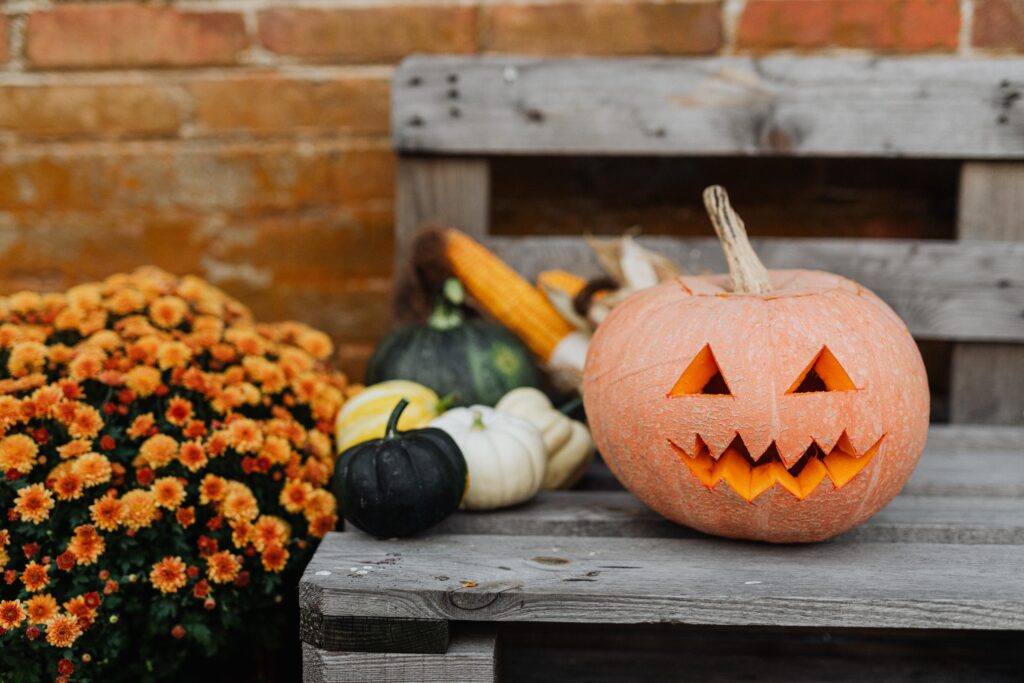
When Irish immigrants came into the US, Halloween skyrocketed as a nationwide festivity. They were also the reason behind one of Halloween’s ex-libris. Ever wondered why are pumpkins associated with Halloween? Yes, they they are the reason why!
Jack-o’-lanterns are original from Ireland. They are based on a folk story called Stingy Jack. Long story short, when Stingy Jack died, he was neither accepted in Hell nor Heaven due to his mischief. As the story goes, Jack roams the Earth until today, carrying a piece of coal burning in a carved-out turnip.
This tale led people to carve scary faces in turnips and potatoes. They would then place them in their windows and front doors to keep Jack and other evil spirits away.
Instead of using turnips, Irish immigrants began using pumpkins to build Jack-o’-lanterns. Pumpkins were abundant in America.
Today Halloween is celebrated pretty much all around the world. It has greater expression in some countries than in others, but adherence has increased over the years. Spotting a Halloween pumpkin head is not that unusual anymore.
What Happens to Pumpkins After Halloween?
According to Hubbub, in the UK alone, 14.5 million Halloween pumpkins go to waste. These would be enough to feed the UK’s population with at least a bowl of pumpkin soup.
This also adds up to the food waste problem we face around the globe. One-third of food goes uneaten and ends on waste. This is a staggering number when there are 829 million people starving worldwide. On top of it, recent warnings about future food shortages make this waste even more outrageous.
How to Reduce Food Waste this Halloween
Should you quit doing Jack-o’-lanterns then? No, not at all. You can avoid food waste though, and educate others about it too. What can I do with my pumpkin after Halloween?, you might be asking. Well, instead of buying pumpkins and only using them for decoration, you can learn how to make the most of them.
Here are three ways to nutritionally benefit from their goodness and prevent food waste.

Preserving Your Pumpkin Seeds
Pumpkin seeds have been used in many cultures as medicine. They are known to be useful in the treatment of urinary problems, kidney stones, and high blood pressure and sugar. They contain antioxidants, protein, good fats, vitamins, and minerals.
Once you wash your pumpkin and cut a hole on top of it, remove its guts. Separate the seeds and wash them to remove all the strings. Set the remaining guts to a side. They can be used too later.
Next, spread the seeds on an oven tray and sprinkle them with your favourite seasoning. To make them savoury, you can use garlic salt, cayenne pepper, or chilli powder. To make them sweeter, you can add pumpkin pie spice or cinnamon.
Bake the seeds at 180C for 10 minutes or until they turn light brown.
Using Your Pumpkin Guts
You can use your pumpkin’s guts to make vegetable broth. Add it to other vegetable scraps you may already have. Vegetable broth helps reduce cholesterol and lower blood pressure.
Another interesting way to use pumpkin guts is to sauté them with a little bit of olive oil and blend them with chickpeas. This way you will have creamy and delicious hummus.
Adding Pumpkin Flesh to Meals and Desserts
Pumpkins’ flesh is packed with nutrients and it can be used to prepare several different meals and even desserts. To make sure you make the most of your Halloween pumpkin, you can cut it in half. Don’t worry, you can put it back together with a bit of super glue! Just make sure you leave some margin on the sides. One to two centimetres should be enough.
Once you slice it into two, you can use a melon baller to make sure you scoop as much flesh as you can. There are different ways you can conserve the flesh.
You can either freeze it, or you can roast it right away. To puree your pumpkin flesh, you can put it in a food processor or blender until you get your desired texture.
You can add the pumpkin puree to your usual cooking recipes. You can add it to your muffin, pie, and bread recipes. Or simply have it as a complement to your main meal.
Pumpkin also gives a great flavour to soups, curries, and stews.
Final Thoughts
Pumpkins are very nutritious and surprisingly low on calories. They are rich in Vitamin A and a good source of Vitamins K, E, B2, B6, and C. They also contain important minerals such as copper, iron, magnesium, and potassium.
These nutrients play important functions in metabolism and cellular maintenance. They are very important for musculoskeletal and mental health. Plus, they are key when it comes to securing a good immunological defence.
By making the most of your Halloween pumpkin, you are contributing to your health and well-being. More importantly, you are consciously preventing food waste. This helps protect the planet’s well-being too.
About the author
Vanessa is an accredited Well-being Coach with a master’s degree in Psychology. She is the founder of WellbeingMedia.blog, where she helps creative and sensitive people thrive through well-being education.
Pin this!



Thank you! Beyond the seeds, I did not know to use the pumpkins insides.
I hope you got some good ideas from this post!
Loved reading these ideas, we tend to go scatter them in our local field/park for the animals. Makes us feel good about the environment x
http://Www.nadinealex.blogspot.com
Yes that’s definitely what I’ll be doing with mine this year.
That fact about pumpkin waste is shocking! The fact that everyone in the UK can have the equivalent of a bowl of pumpkin soup with the pumpkins we waste every year is mindblowing! I love the ways you’ve come up with to make the most of your Halloween pumpkin! x
Lucy | http://www.lucymary.co.uk
It is quite shocking isn’t it?!
This is a fantastic post, and honestly, I worry every year about tossing a perfectly good pumpkin and now I have this post to refer to with some ideas! Thanks!
I hope you get to do something else with your pumpkin this year!
This is such a useful and informative post! Thanks for sharing these tips, baked or roasted pumpkin seeds make for a great snack and I’m definitely going to try using pumpkin in my baking.
I hope you enjoy your pumpkin baking!