When you think of Halloween there are certain creatures and monsters that always spring to mind. The ones that always feature on Halloween decorations and costumes. The classic Halloween crew if you will. Tales of these spooky beings have been around for hundreds if not thousands of years, but where exactly did the stories come from? Let’s take a look at the origins of seven classic Halloween monsters.

Mummies
We all know the ancient Egyptians are famous for their mummification process but it’s not a practice exclusive to them. In fact some of the oldest mummies in the world have been discovered in Chile. They were created by fishing communities called the Chinchorro. There’s evidence of these Chilean mummies dating all the way back to around 6000 BC.
But it’s safe to say it’s those Egyptian mummies that really did a lot for the popularity of this classic Halloween monster. But how did something that was created so long ago become so popular thousands of years later? Well you’ve got the Egyptology phase of the early 19th century to thank for that. Mummies were often brought back to the U.K. by wealthy tourists and mummy unwrapping parties were hugely popular. By the start of the 20th century mummies were gaining notoriety as a horror trope. In 1904 Bram Stoker wrote The Jewel of Seven Stars. The story told of an Egyptologist attempting to resurrect a mummy. This played right into the popularity of all things Egyptian.
It perhaps wasn’t until 1922 though the idea of mummies and curses really took hold. In November that year archaeologist and Egyptologist, Howard Carter discovered the undisturbed tomb of Tutankhamun. Fuelled by the discovery, newspapers began to run stories of a curse (probably to sell a few more copies). When the financier of the Tutankhamun expedition, Lord Carnarvon, died just 5 months after the opening of the tomb things just naturally exploded from there. By 1932 the idea of mummies as horror icons had made it to the big screen with Boris Karloff’s film – The Mummy. From that point on mummies have been a firm horror and Halloween favourite.
Headless Horseman
Many credit Washington Irving’s 1820 novel The Legend of Sleepy Hollow with the creation of the headless horseman. Maybe because it was so well written and designed to look like it had been discovered amongst the papers of a (fictional) historian. But the truth is Irving wrote his famous novel while on a tour of Europe. If you dig around enough you can see those European influences from folklore and myths of places such as Ireland, Germany, Scandinavia and Britain where tales of headless horsemen are staples.
The Dullahan is a famous Irish mythological figure. We have the Irish to thank for many of our Halloween traditions so it’s only right that a classic Halloween creature would have its roots there too. The legend of the Dullahan tells of a harbinger of death who roams the roads calling out the names of those doomed to die. He carries his head under one arm and the flesh of his face decayed. The Dullahan is said to be an embodiment of Crom Dubh, a fertility god that demanded blood sacrifice in the form of decapitation.
Another influence of Irving’s story is that of The Wild Hunt, a popular Northern European folktale. It tells of a procession of ghostly hunters chasing souls. The idea of a hunting party on horseback is undeniably a big influence on the story of the headless horse that we all know today.
Witches

Popular culture has given us a whole host of witches from the likes of Hermione Granger, Sabrina the Teenage With and the Sanderson Sisters. But the history of witches goes way back and it’s not quite as great for women as all these modern day witches would have us believe.
Witches are actually mentioned in the Bible which is the earliest record. They are mentioned in the book of Samuel which is thought to have been written between 931 BC and 721 BC. There are also other Old Testament versus that warn against chanting, divination and the use of witches to contact the dead.
Witch hysteria landed in Europe in the middle ages where women were accused of a variety of evil behaviours. Many of the women confessed to such behaviours but torture was often used to extract these confessions. Witch hunts became hugely popular and many of the accused women were executed by hanging or been burnt at the stake. Widows, single women and others that didn’t quite fit into society were the ones that were targeted by witch hunters the most. This is where it’s clear to see why women on the outskirts of society were easy targets. Many of the women accused of witchcraft were actually Wiccan’s, natural healers or wise women. What they did was deeply misunderstood and properly totally out of place for women at that time so the easiest thing to do was blame them for doing the devils work.
Just as the witch trials seemed to be calming down in Europe they were just getting started in America. War, smallpox and the fear of attack by Native Americans all led to a feeling of unrest in the 1600s. And what happens when there’s social disorder? You need someone to blame of course. The best known witch trials by far are of course the Salem Witch Trials which took place in 1692. Compared to the European hunts are trials Salem actually only accused around 150 people of witchcraft and only executed 18. Surprisingly 6 of those were men. Salem wasn’t the only colony to have witch trials but thanks to Hollywood it’s definitely the most famous.
Nowadays Wicca is recognised as an official religion in America and Canada. However there are still many countries around the world that persecute women and men for witchcraft.
Clowns
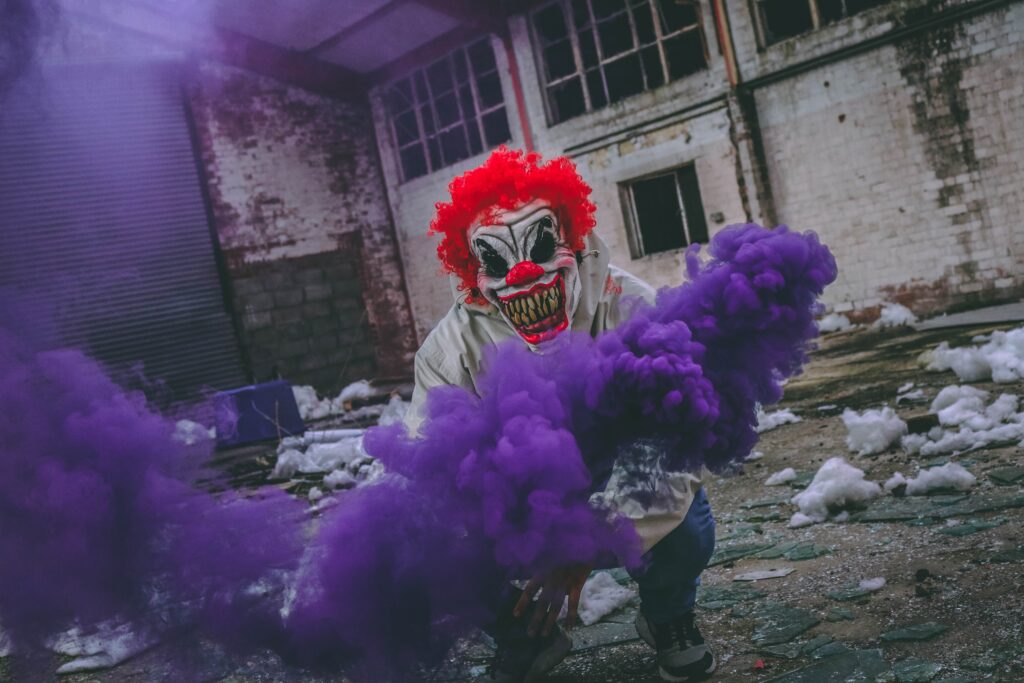
Although clowns are meant to be a source of fun and entertainment many people actually have a phobia of them. Coulrophobia is described as the extreme or irrational fear of clowns. So how did clowns go from a form of children’s entertainment to having a reputation as creepy killers? Well a real life murderer might just be responsible for that.
The idea of clowns being evil actually started around the mid 1800s with Edgar Allan Poe’s short story Hop-Frog which told of a court jester seeking revenge. In 1892 the opera Pagliacci featured a killer clown. But what perhaps cemented the idea of clowns being creepy killers was the string of murders committed by John Wayne Gacy throughout the 1970s. Gacy often performed at children’s hospitals or charitable events as one of his clown personas – Pogo the Clown or Patches the Clown. During his time as a clown John Wayne Gacy also committed at least thirty three murders which lead to him becoming known as the Killer Clown.
The killer clown trope continued into the 1980s when Stephen King published his book, It, featuring Pennywise the Dancing Clown who lures children to their deaths. By 1990 Tim Curry had taken on the role of Pennywise in a TV miniseries. Just four years later John Wayne Gacy was executed by lethal injection. From that point on there’s been a steady stream of killer clowns in popular culture. From the Joker to Twisty the Clown in American Horror Story.
Vampires
When you think of vampires you probably think of Count Dracula from Bram Stoker’s 1897 novel Dracula. But vampires already had a long history way before Stoker made them famous. In fact we can jump back to the Middle Ages again for this one but this time we’re hopping over to Eastern Europe.
Vlad the Impaler or Vlad Dracul to give him his proper name was born in Transylvania, Romania. He ruled in Walachia on and off between 1456-1462. Some people believe Bram Stoker based Count Dracula on Vlad whilst others think it was just a mere coincidence. Either way there are some striking similarities between the two. Vlad Dracul earnt his nickname due to the fact that his favourite way to kill his enemies was to impale them on a wooden stake. There’s also a very gory rumour that Vlad enjoyed eating amongst his dying victims and that he would dip his bread in their blood.
However it would seem that a lack of medical knowledge during the Middle Ages is what added fuel to the fire of the vampire legend. The Plague was rife, and swept through towns, one of the symptoms of the Plague was bleeding mouth lesions which to the scared and uneducated became a sign of vampirism. Another medical condition, porphyria can also be linked to vampire tales. Porphyria is a blood disorder that can cause the skin to blister when exposed to sunlight. However people took no chances when it came to vampirism. There’s reports well into the 19th century stating that when anyone who was suspected of being a vampire died strong measures were taken to make sure they didn’t come back. These measures ranged from a stake through the heart to decapitation and the burning of corpses.
These days it’s been proven that vampires like Dracula don’t exist. However there are communities of people out there that call themselves vampires. And yes they do drink blood. Self-identified vampires tend to be small communities that keep to themselves and drink the blood of willing private donors.
Ghosts
Ghost stories have been around for thousands of years. They are a firm fixture in the folk tales of cultures all over the world. Ghost sightings have been recorded since Roman times and ghostly stories and spooky figures seem to be the thing we love most of all. Many people will quickly tell you there’s no such thing as a werewolf or a vampire but a ghost? Well they’re the thing many of us believe just might be real.
Ghost stories have been recorded all the way back from the first century AD. From then on many Greek and Roman writers wrote down ghost stories. It wasn’t until 856 AD though that a different type of ghost was first reported – a poltergeist. A family living in a farmhouse in Germany reported being tormented by stones being thrown and fires being lit.
Funeral rituals actually started as a way to prevent ghosts. The idea being that your spirit exists separately from your body so therefore may continue to exist when you die. Funeral rituals were seen as a way to make sure a dead person’s spirit didn’t return. Haunted places are usually believed to have some link to the person haunting them. Aside from actual visions of ghosts a haunting can range from noises and lights to breezes and cold spots.
There have been many attempts to make contact with ghosts over the years. Seances with the use of mediumship, Ouija boards and even instruments have all been used. The Victorians were renowned for dabbling with all things other-worldly, this is due to the birth of spiritualism in this era. Spiritualism was a social religious movement that explored what came after death and the possibility of communication between the living and the dead.
So why are so many of us on the fence about the existence of ghosts? Well quite simply, ghosts put our very existence into perspective. If ghosts aren’t real then what happens after death?

Werewolves
Werewolves stories go way back and are deep rooted in many folk tales all around the world. Early mentions of werewolves come from the Epic Of Gilgamesh which was written between 2100 BC and 1200 BC. In fact Gilgamesh is believed to be the oldest surviving piece of Western prose. Werewolves also appear in early Greek mythology with the Legend of Lycaon in which Lycaon was turned into a werewolf by Zeus.
Again though, lack of medical knowledge spurred on werewolf stories. There are quite a few conditions that lend themselves to werewolf like symptoms such as rabies, hypertrichosis and even hallucinations. While we know about these medical conditions now, someone presenting with symptoms from these conditions a few hundred years ago would have been treated very differently.
While werewolves have appeared in many stories over the years they arrived in Hollywood a little little than other Halloween monsters. In 1941 The Wolf Man was released and became hugely popular, therefore cementing the werewolf as a classic horror trope.
So there you have it, the strange origins of seven classic Halloween monsters. As you can see these creatures go way back in history and their beginnings are usually deeply rooted in folklore. A fascination with the weird and wonderful, lack of medical education, a need for scapegoats in society and even Hollywood are all responsible for making these Halloween monsters into the creatures we love to get spooked by today!
Pin this!


I didn’t know any of these, barring the mummy thing, but I didn’t realise mummification didn’t just happen in Egypt. What an interesting read! Thanks for putting this together, it’s so cool!
Claire.X
http://www.clairemac.co.uk
Thank you so much for reading. I think this is one of my favourite pieces of Halloween content I’ve ever created so I’m glad you enjoyed it!
My son loves all things spooky! Thanks for sharing, I will have to tell him about this. Thanks!
Thank you for reading!
Brilliant post! I love history, I am scared of ghosts but not scared to read about ghosts and spooky things.
I’m glad you enjoyed the history side of it!
This was so cool to read! I love this time of year with all the ghosts and ghouls; add to that my interest in folklore and history and it makes for some fascinating reading!
It was such a good post to research and create. I love anything like this so I’m glad you enjoyed it too!
Wow what an interesting read! I honestly never thought about Halloween monsters and their origins! x
Lucy | http://www.lucymary.co.uk
I had so much fun creating it so I’m glad you found it interesting!
This is such an interesting post and my little one would probably love to hear about where all this came from!
Thank you, I’m glad you found it interesting!
Wow, this was such a great post. It’s great learning about the origin of these Halloween monsters. Folklore and lack of medical education seem to play a major role in their origin. Thanks for sharing.
Yes they were certainly big factors. Thanks for reading!
What a cool post! I didn’t realize where some of these came from. Especially the werewolves story was interesting I learned a lot from this post thanks for sharing! 🙂
I’m really glad you found it interesting!
This is terrific! I l love spooky season and I really enjoyed reading about these Halloween Monsters.
Thank you, I’m glad you enjoyed it!
Super interesting!!!
Thanks!
To me, Halloween is just a commercial celebration. Learning about the costumes origin is interesting. Thank you for sharing.
Thanks for reading. It’s definitely become very commercialised but it has some really interesting origins.
loved this post! it was a perfect read for this time of year and so interesting. loved learning about the histories of these creatures. i especially love learning about witches and the history behind the covens and salem. would love to visit salem as well and take a tour about the witch trials.
Salem is at the top of my list for places to visit, I bet it’s really good at this time of year too!